Math Monday: Gamify Your Review with a Scavenger Hunt!
Sick of repetitive math worksheets? Try out a scavenger hunt! It brings excitement to your practice questions or unit review. This Math Monday, we’re highlighting a scavenger hunt activity from our Financial Algebra unit on Investing Strategies & Exponential Functions.
The Activity
MOVE: Follow the Funds is a scavenger hunt where students race to answer questions about exponential functions and types of investment funds. They follow a trail of clues, each one leading to the next card.
This activity is part of Financial Algebra Unit 6: Investing Strategies & Exponential Functions, and it works as a stand-alone review for any class covering exponential equations.
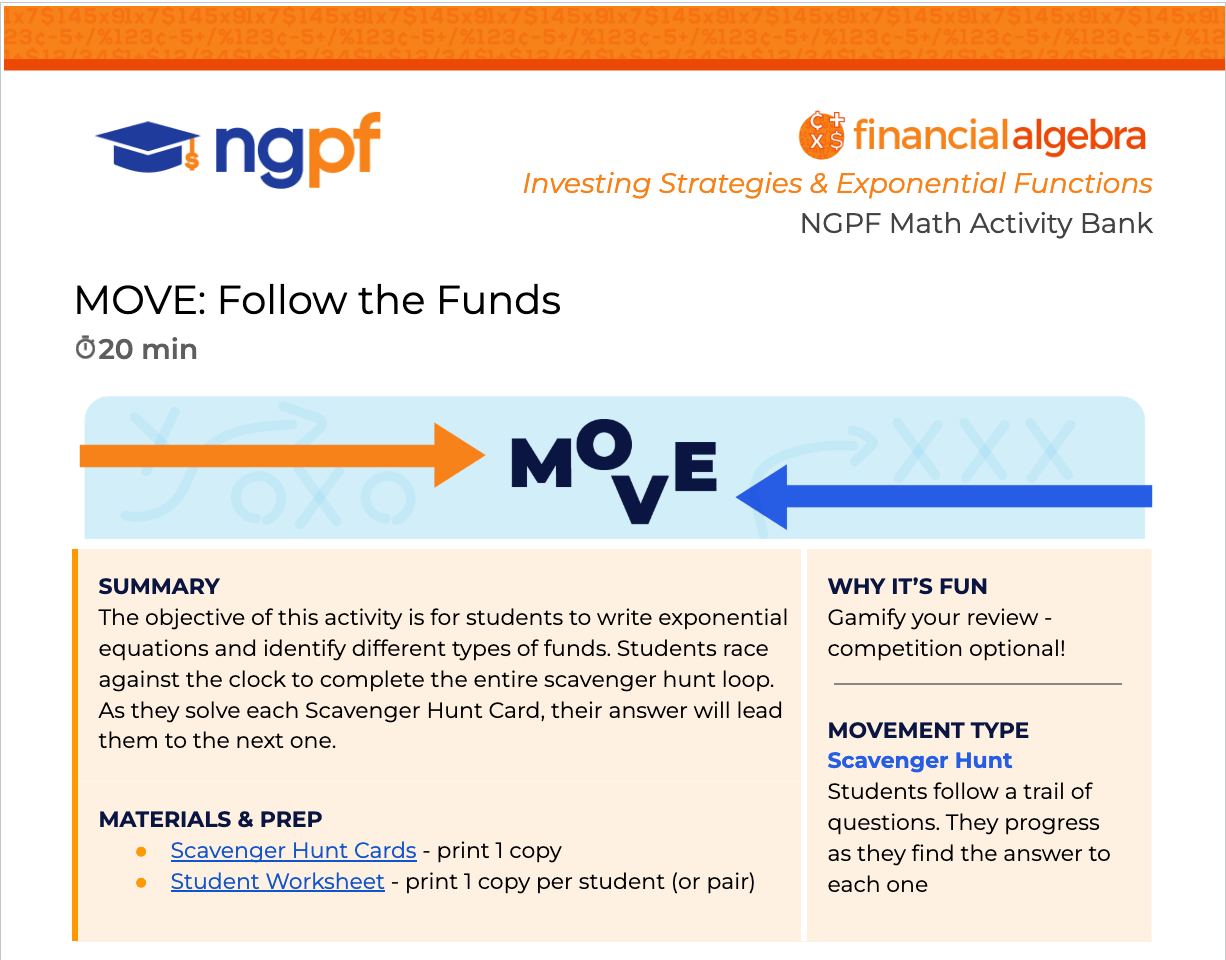
How it works:
- Print one set of Scavenger Hunt Cards and hang them around the room.
- Give each student (or pair) a copy of the Student Worksheet
- Students start at any card, solve the question, and use their answer to find the next card. They track their progress on the Worksheet.
- Teachers can quickly check students' answers by looking at the sequence of card letters that they track on their Worksheet.
Example Walkthrough
Let’s walk through part of the activity with an example student, Naomi.
Naomi has a copy of the Student Worksheet. She walks over to a Scavenger Hunt Card hanging on the wall. It’s labeled “A” and has the question: “Which type of fund adjusts its portfolio over time, based on when you plan to retire?”
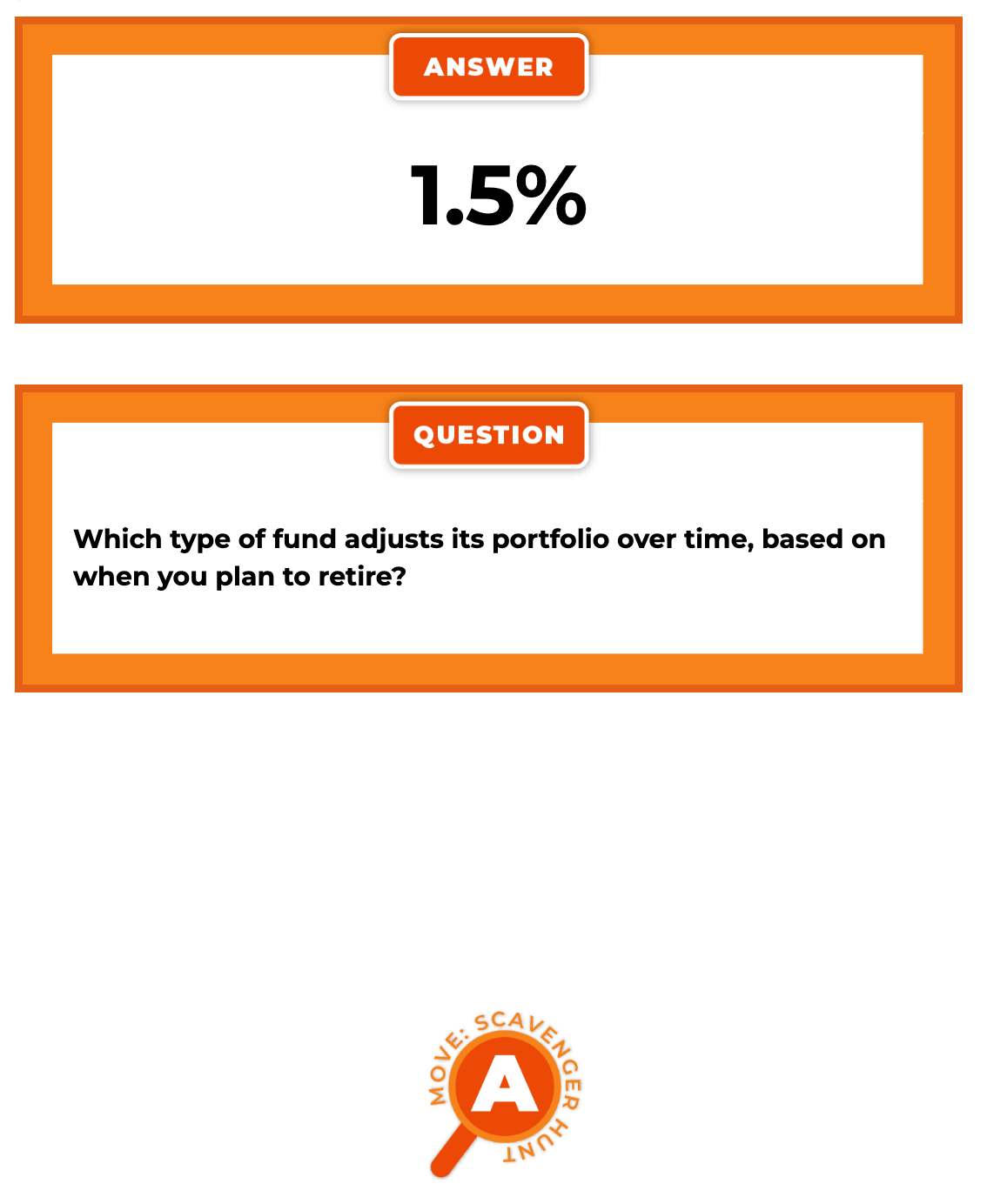
Naomi knows the answer! She fills in her Student Worksheet by writing the card letter (“A”) and the answer (“TDF”).
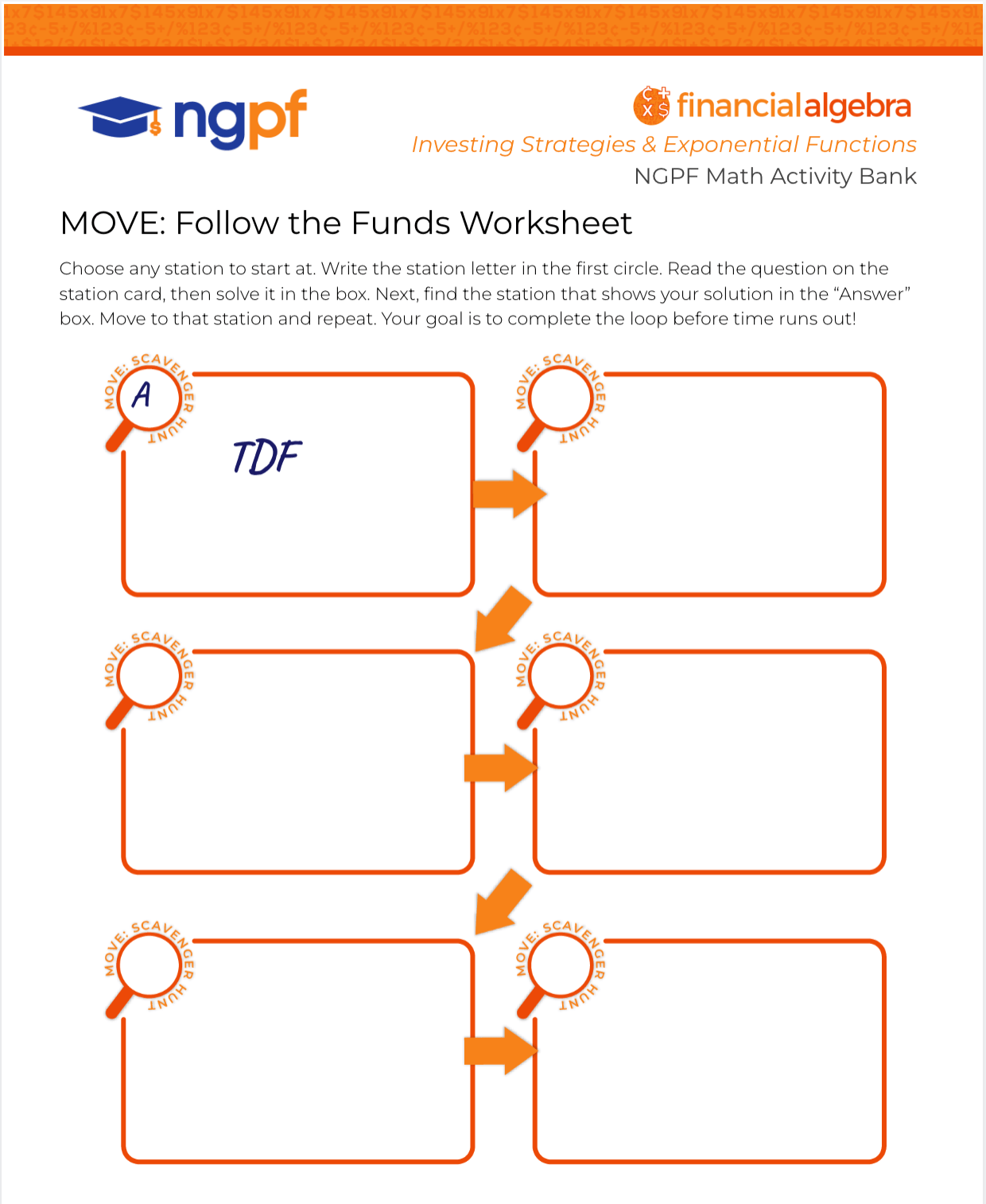
Now, Naomi is ready to find her next Scavenger Hunt Card. She looks around the room for a card that has the answer “TDF” written at the top. That’s where she needs to go next!
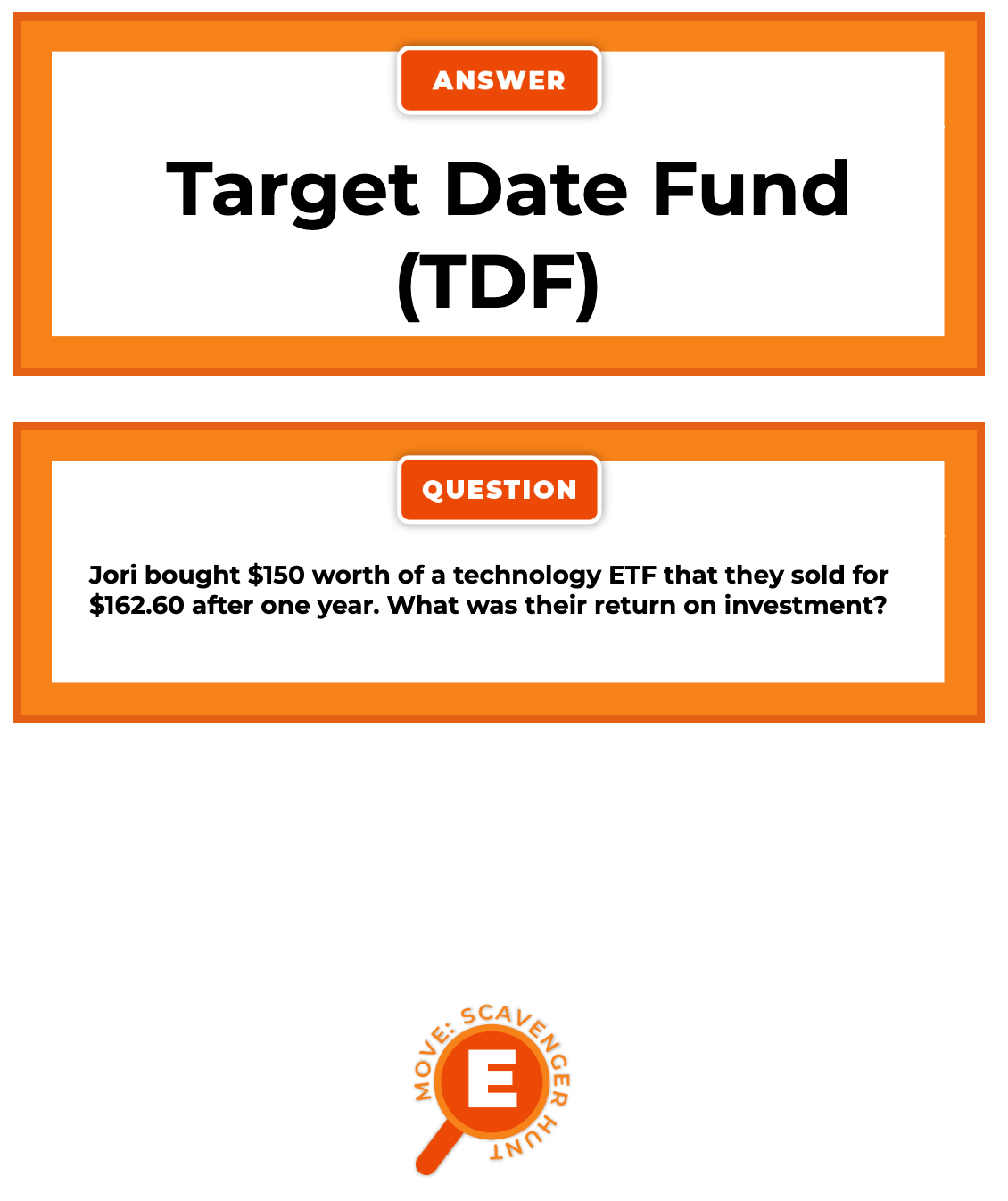
She finds the Scavenger Hunt Card she was looking for! It’s labeled “E”, so she fills that in on the next box of her student worksheet. Then, she starts solving the question on this card. Once she’s found the answer, it will lead her to the next Scavenger Hunt Card.
Naomi will continue this way until she gets back to the Scavenger Hunt Card that she started on (“A”). Naomi brings her worksheet to her teacher, who can easily check her work by looking at the order of the Scavenger Hunt Card letters. (Tip: Find the answer key by clicking on the activity link while logged into your verified teacher account!)
Make Your Own: Turn Any Worksheet into a Scavenger Hunt
The scavenger hunt format is flexible enough to adapt almost any practice set. Here's how:
- Choose your problems. Pick 8–12 questions students can solve in roughly the same amount of time.
- Letter your cards. Label each card with a letter (A, B, C…) and write one question per card.
- Connect the answers. At the top of each card, write the answer from a different card. The answer at the top of Card D is the answer to the question on Card A — and so on. The chain should loop back to where it started - but should NOT go in alphabetical order.
- Hang and run. Spread cards around the room, give students a worksheet to track the letters and answers, and let them go.
More Ideas for Review
- MOVE: Paycheck Scavenger Hunt - Try out another scavenger hunt activity, this time focused on taxes and percentages. Students work through real-world paycheck calculations, like gross and net pay, deductions, and tax rates.
- PLAY: Final Review Jeopardy - This exciting and competitive game includes 35 questions to review the most important personal finance vocabulary and content students need to know. Find it under the Semester Course Course Materials.
- Note: This activity covers similar personal finance content as the Financial Algebra Course, but you’ll have to add any math content you want
- CREATE: My Financial Flipbook - In this summative project , students record their biggest takeaways from each unit. Find it under the Financial Algebra Course Materials listed as the “Summative Project”
- Myth or Fact - Check out PLAY: Myth or Fact About Your Credit Score or use those slides as a template to create your own.
- Unit Reviews - You can find comprehensive personal finance study guides in each unit of the Semester Course. For example, here is the Banking Unit Review.
- These include a summary of core topics, vocab review, questions on core concepts, and a 20-question multiple choice quiz.
- Note: These reviews cover similar personal finance content as the Financial Algebra Course, but you’ll have to add any math content you want
Share What's Working
We'd love to hear how you use scavenger hunts in your classroom! Join FinLit Fanatics to share your tips, tricks, and wins!
About the Author
Kathryn Dawson
Kathryn (she/her) is excited to join the NGPF team after 9 years of experience in education as a mentor, tutor, and special education teacher. She is a graduate of Cornell University with a degree in policy analysis and management and has a master's degree in education from Brooklyn College. Kathryn is looking forward to bringing her passion for accessibility and educational justice into curriculum design at NGPF. During her free time, Kathryn loves embarking on cooking projects, walking around her Seattle neighborhood with her dog, or lounging in a hammock with a book.
SEARCH FOR CONTENT

Subscribe to the blog
Join the more than 11,000 teachers who get the NGPF daily blog delivered to their inbox:
MOST POPULAR POSTS